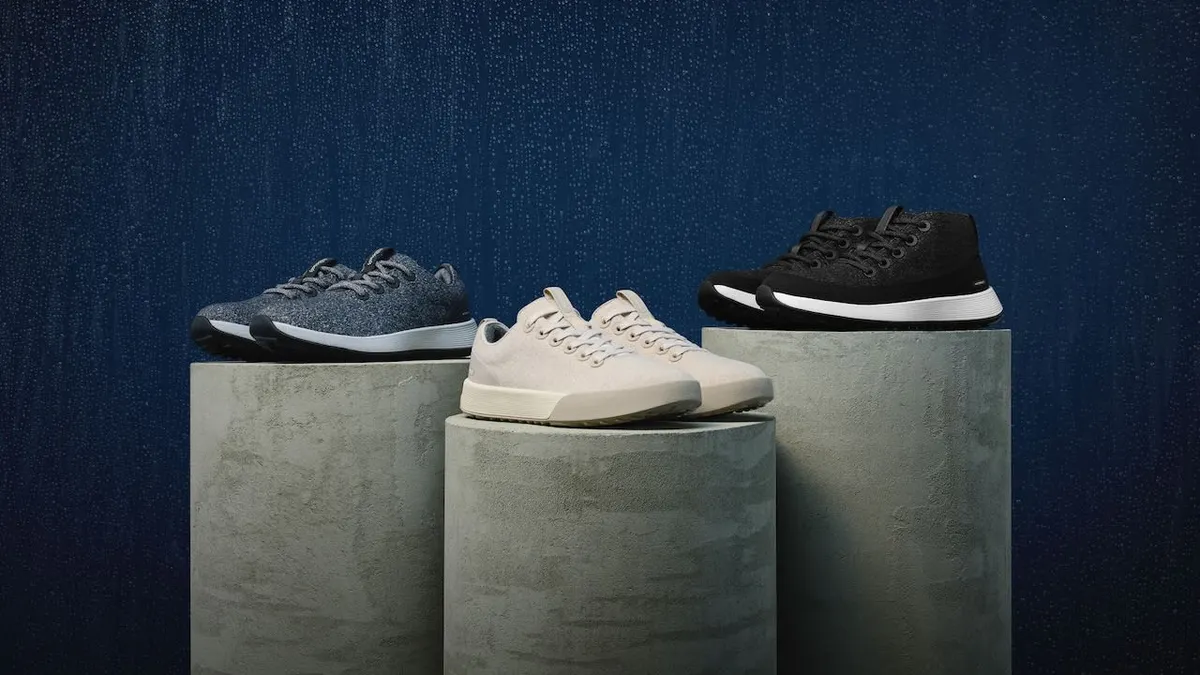
Springtime is a good time for most birds, but not Allbirds.
In the past few weeks the direct-to-consumer shoe brand has made moves emblematic of its startling descent, from unicorn status and a valuation in the billions on the day of its initial public offering. Last month the conglomerate that owns Aerosoles snapped up its intellectual property and some other assets for a relatively paltry sum: under $40 million.
The remnants of the company, to be dubbed “NewBird AI,” will become a tech firm specialized in “AI compute infrastructure, with a long-term vision to become a fully integrated GPU-as-a-Service (GPUaaS) and AI-native cloud solutions provider.” The latter move confused a lot of observers, though it did spike the share price and garnered $50 million from an unnamed investor.
“It is arguably an inauspicious end for Allbirds as a stand-alone business and is another signal that the DTC bubble has now firmly deflated,” GlobalData Managing Director Neil Saunders said in emailed comments following the acquisition announcement.
It’s true that Allbirds joins a growing list of DTC brands that have fallen from what had been lofty perches, but there are other reasons for its downfall.
“I've heard people blame it on DTC, but I don't think that to be true,” Jessica Ramírez, co-founder and managing director of The Consumer Collective, said by phone. “I think DTC is a good channel when used properly. It’s more about — is your product evolving with consumer needs? And is it evolving with the market? Is it actually something of interest? Which I don't think Allbirds was.”
The sustainability pitch
A key Allbirds differentiator is its use of innovative materials, made from recycled and natural sources. But the company may not have appreciated that even the consumers laser-focused on the environment would want more.
“Indeed, sustainability comes way down the batting order behind factors like style, price and comfort,” Saunders said. “Allbirds could have leaned into any of these things alongside its green credentials but largely chose not to do so.”
Anyone looking closely at Allbirds’ supply chain may have quibbled with its claims, given the carbon footprint, according to Matt Powell, senior adviser with BCE Consulting. Even if the supply chain were squeaky clean, though, the brand would have needed the right merchandise.
“The materials themselves were sustainable, but they sheared the sheep in New Zealand, they shipped the wool to Milan and had it woven. They shipped the woven wool to Korea, had it made into a shoe and shipped it to the United States,” Powell said in an in-person interview. “But in no way was that the issue. It really was that there just wasn't enough freshness to the product, any reason to buy another one. And the designs were pretty basic.”
Not performance, not fashion
Ultimately Allbirds didn’t understand its own customer — someone interested in a sneaker to wear around town. A shoe that didn’t require the performance necessary for athletics but would be stylish for various venues.
This was a huge opportunity, but Allbirds focused more on growth than execution, according to Liza Amlani, principal at Retail Strategy Group.
“They don't actually understand their retail consumer or how to create product, or the retail end to end,” she said by phone. “They thought they needed 100 stores, and then they needed to fill those doors.”
The brand ran about 60 locations at its peak, and in January announced it would shutter the rest of its full-price fleet, leaving open just two outlets and two London stores.
Even more, though, Allbirds stuck with what amounts to a walking shoe. “It does come down to the products not evolving with consumer interest or consumer need,” Ramírez said.
In effect, the footwear is aimed at a fashion customer. But that customer is on the lookout for newness, and Allbirds’ answer to that has been to release the same styles in different hues, according to Powell. In fact the brand this year announced a tie-up with Pantone, a firm that calibrates colors for use in various types of design and manufacturing.
“The only place a lot of color works, in my opinion, is an inexpensive shoe, like a Chuck Taylor,” Powell said. “And, still, the bestselling colors on the Chuck Taylor are white and black. You can extend the color so far, but only so far, and you don't need 36. At Allbirds that was the differentiation — do color, do more color — but that wasn't what the consumer was looking for.”
Because Allbirds didn’t evolve its product, it lost the very cohort most attracted to it. As part of its turnaround, the company has released new styles like waterproof sneakers and comfy slippers — in more vibrant colors.
It now falls to its new owners to reinterpret the Allbirds shoe.
“It felt like a sneaker, but it wasn't. But once you're halfway there, the next obvious place is — you're wearing sneakers. It just drifted off,” Powell said. “At the end of the day, fashion killed Allbirds.”